Analysis

Why there is no single vanilla taste

Vanilla is one of the most widely consumed spices in the world, and the one that most captures the imagination. While vanillin is its dominant note, more than two hundred aroma compounds contribute to building the sensory profile of a cured bean.

Three mechanisms that build the profile

A bean brings together phenols, aldehydes, acids, esters and lactones. It is their interplay that builds the sensory richness of vanilla, and it relies on three mechanisms.

The three mechanisms

Dominance

Vanillin shapes the overall profile.

Interaction

Compounds enhance one another: roundness, warmth, indulgence.

Masking

Some notes soften, balance and round off others.

  • Dominance, first: some molecules shape the overall profile, vanillin first and foremost.
  • Interactions, next: compounds can enhance one another, creating roundness, warmth or indulgent notes.
  • Masking, finally: some notes soften or balance other compounds, preventing harsh or unbalanced profiles.

The direct consequence for formulation: two products with the same amount of vanillin can show very different profiles, depending on the presence or absence of these secondary molecules.

The matrix changes perception

The taste of vanilla is not limited to its chemical composition: it depends on how it is perceived.

Aroma perception varies with the food matrix (ice cream, chocolate, cookie, beverage), with sugar and fat content, and with interactions with other flavors.

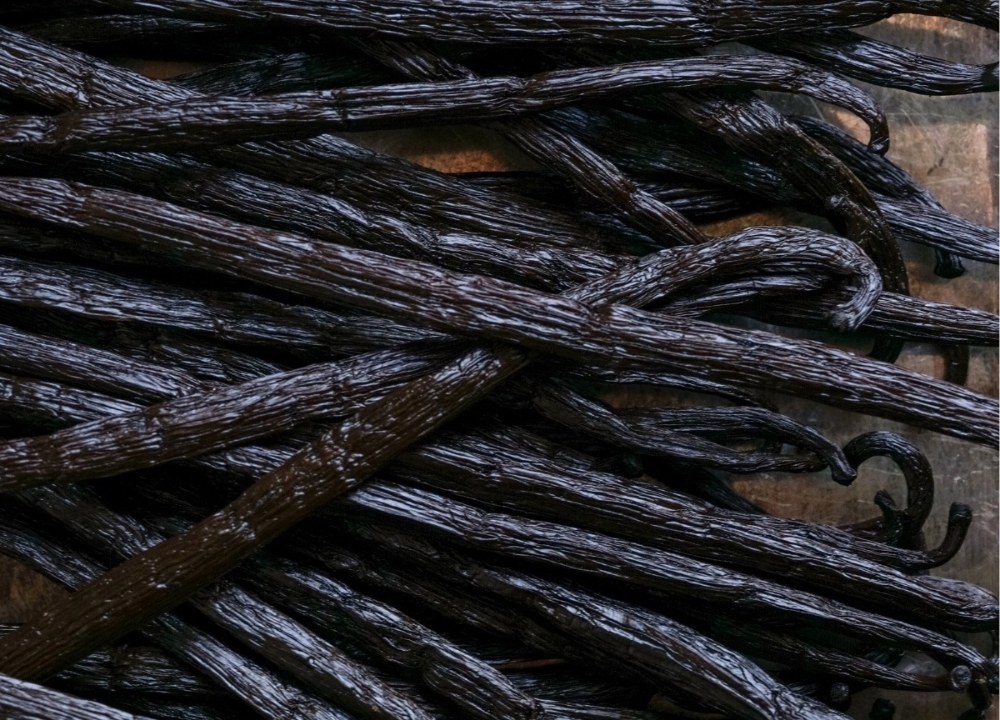
Close-up of black vanilla beans covered with fine white needles: vanillin that has crystallized naturally on the surface, known as frosting, a sign of high vanillin content.
Natural crystallization of vanillin on the surface of a “frosted” vanilla bean. Source: Eurovanille, 2026

The same vanilla will therefore seem longer-lasting in a high-fat dairy base, more subtle in a complex sweet matrix, or warmer and more caramelized when baked.

A taste as much learned as perceived

Associated with childhood, indulgence and comfort, vanilla carries strong emotional value. This emotional dimension influences final perception as much as the chemistry does.


From a scientific standpoint (Mennella & Beauchamp, 1996), this sensitivity may stem from early sensory exposure: some aroma compounds, including vanillin, can pass into breast milk depending on the mother’s diet, helping to build an early familiarity with these notes.


The taste of vanilla is thus the product of a benchmark that has become universal and of culinary uses that remain very diverse, from European desserts to Asian dairy preparations.

What the White Paper adds

  • The global standardization of vanilla taste and the role of tasting panels: experts, professional users and consumers.
  • The story of vanilla and ice cream, up to Thomas Jefferson’s handwritten recipe.
  • The analysis of how the taste of vanilla is cognitively built, its scientific sources and the perspective of Eurovanille’s R&D Director.

Blog

Recent Articles

Stay up to date with the latest from Eurovanille and share our love of exceptional vanilla!

  • All Posts
  • Agronomy R&D
  • CSR
  • Innovation
  • Tips & Advice
  • Trade Shows